
Units of measure
In some cases, handling products in different units of measure (UoM) is necessary. For example, a business can buy products from a country that uses the metric system, and then sell those products in a country that uses the imperial system. In that case, the business needs to convert the units.
Another case for unit conversion is when a business buys products in a big pack from a supplier, and then sells those products in individual units.
Odoo can be set up to use different units of measure for one product.
Configuration
To use different units of measure in Odoo, first go to , and under the Products section, activate the Units of Measure setting. Then, click Save.
Units of measure categories
After enabling the Units of Measure setting, view the default units of measure categories in . The category is important for unit conversion; Odoo can convert a product’s units from one unit to another only if both units belong to the same category.
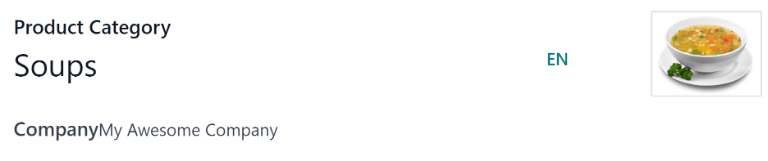
Each unit of measure category has a reference unit. The reference unit is highlighted in blue in the Uom column of the Units of Measure Categories page. Odoo uses the reference unit as a base for any new units.
To create a new unit, first select the correct category from the Units of Measure
Categories page. For example, to sell a product in a box of six units, click the Unit
category line. Then, on the category page that appears, click Add a line in the
Units of Measure tab. Then, in the Unit of Measure field, title the new
unit, such as Box of 6, then in the Type field, select the appropriate size reference,
such as Bigger than the reference Unit of Measure.
If applicable, enter a UNSPSC Category, which is a globally recognized code managed by UNDP.
In the Ratio field, enter how many individual units are in the new UoM, such as
100.00000 when using the example of the centimeter (since a centimeter is 100 times smaller
than the reference unit, 1.00000).
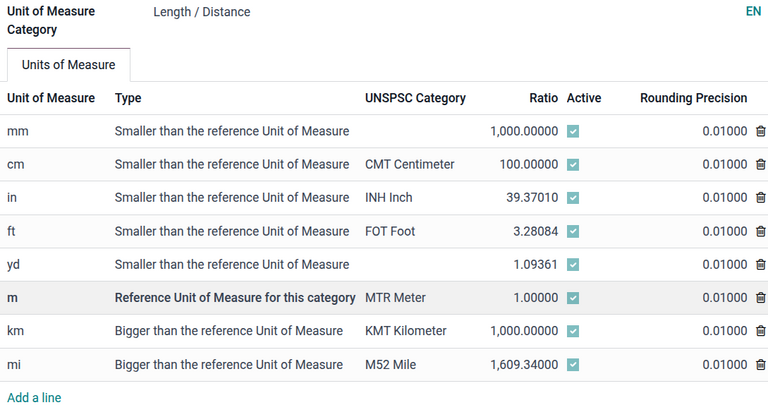
Specify a product’s units of measure
To set units of measure on a product, first go to and select a product to open its product form page.
In the General Information tab, edit the Unit of Measure field to specify the unit of measure that the product is sold in. The specified unit is also the unit used to keep track of the product’s inventory and internal transfers.
Edit the Purchase UoM field to specify the unit of measure that the product is purchased in.
Unit conversion
Odoo automatically converts unit measurements when products have different UoMs and purchase UoMs.
This occurs in various scenarios, including:
Vendor orders: purchase UoM on purchase orders (POs) converts to UoM on internal warehouse documents
Automatic replenishment: generates POs when the stock levels of a product (tracked in UoM) dips below a certain level. But, the POs are created using the purchase UoM
Sell products: if a different UoM is used on the sales order (SO), the quantity is converted to the warehouse’s preferred UoM on the delivery order
Buy products in the purchase UoM
When creating a new request for quotation (RFQ) in the Purchase app, Odoo automatically uses the product’s specified purchase unit of measure. If needed, manually edit the UoM value on the RFQ.
After the RFQ is confirmed into a PO, click the Receipt smart button at the top of the PO.
Odoo automatically converts the purchase unit of measure into the product’s sales and inventory unit of measure, so the Demand column of the delivery receipt shows the converted quantity.
Example
When the product’s purchase UoM is Dozens, and its sales and inventory unit of
measure is Units, the PO shows the quantity in cartons of 12, and the receipt (and other
internal warehouse documents) shows the quantity in units.
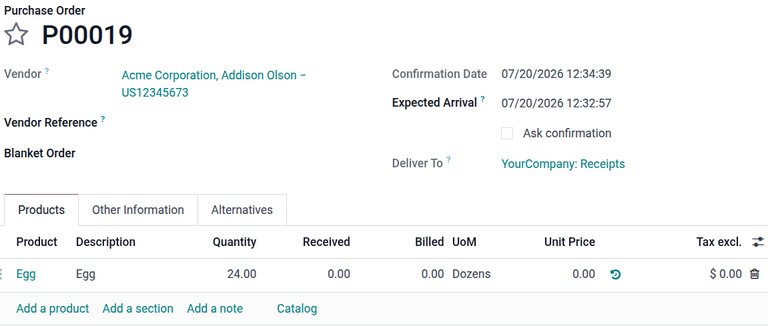
An order of two Dozens, the purchase “UoM”.
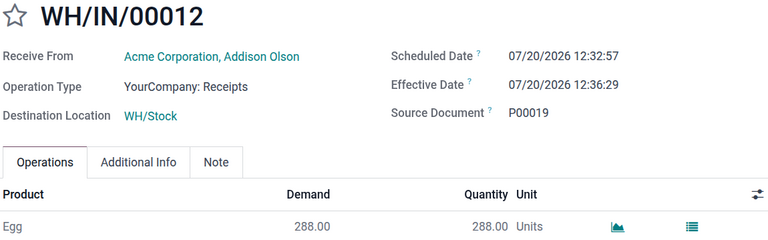
Upon warehouse receipt, the recorded quantities are in the internal “Unit of Measure”:
Units.
Replenishment
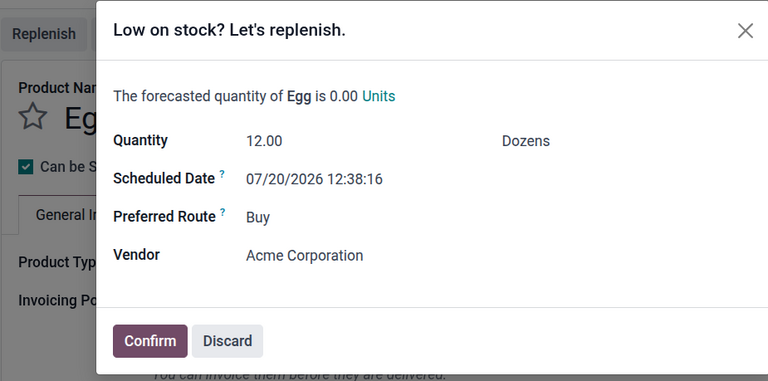
A request for quotation for a product can also be generated directly from the product form using the Replenish button. When replenishing, the purchase UoM can be edited if needed.
Important
A PO can only be automatically generated if at least one vendor is listed in the product form’s Purchase tab.
See also
Sell in a different UoM
When creating a new quotation in the Sales app, Odoo automatically uses the product’s specified unit of measure. If needed, the UoM can be manually edited on the quotation.
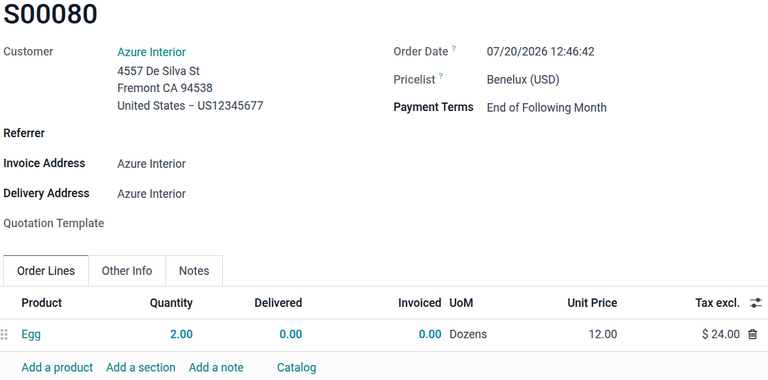
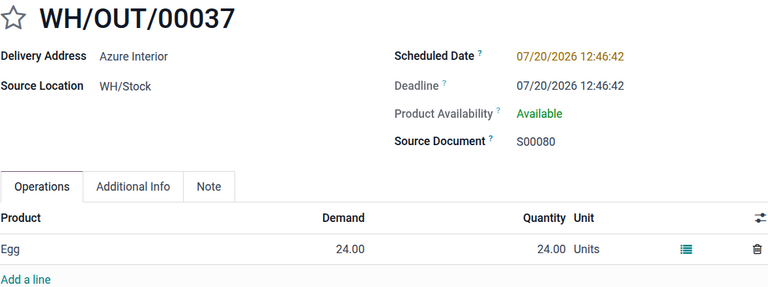
After the quotation is sent to the customer, and confirmed into a sales order (SO), click the Delivery smart button at the top of the SO. Odoo automatically converts the unit of measure into the product’s inventory unit of measure, so the Demand column of the delivery shows the converted quantity.
Example
If the product’s UoM on the SO was changed to Dozens, but its inventory unit of measure is
Units, the SO shows the quantity in dozens, and the delivery shows the quantity in units.
Group units of measure in the POS app
When a customer orders multiple units of the same product at a POS register, the register and the customer display may become cluttered.
Products can be grouped by unit of measure in the POS register and on the customer display.
To do so, follow these steps:
Enable developer mode.
Open the Units of Measure Categories page.
Select a unit of measure category.
Enable the Group Products in POS checkbox.
After this setting is enabled, items are grouped in the POS register. The number of that unit of measure and the price are displayed.
